
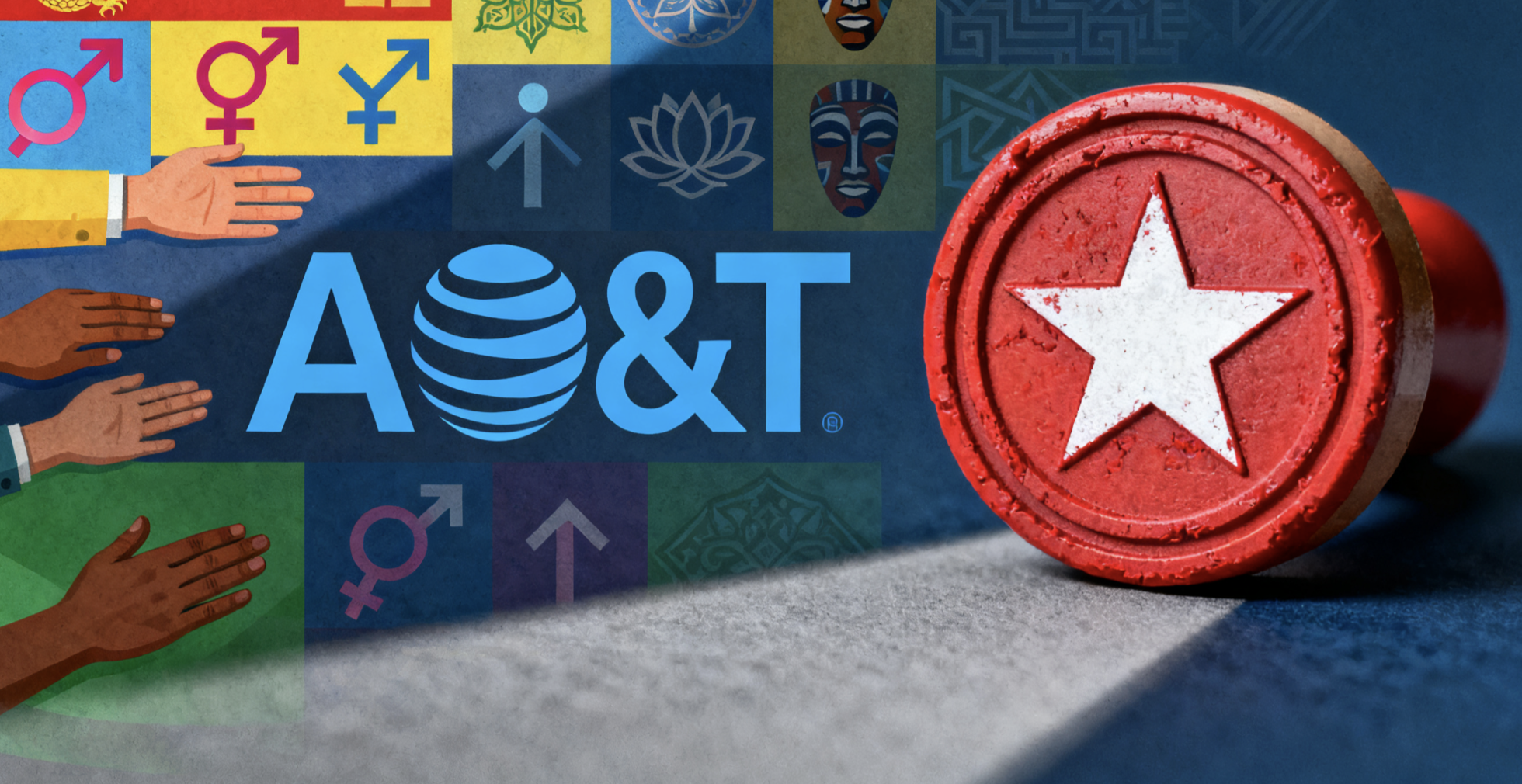
- AT&T told the Federal Communications Commission (FCC) it will end all DEI-related roles and policies, aligning with conditions for approval of its US Cellular spectrum purchase.
- The move reflects a wider trend — other major firms have also dropped DEI programmes amid legal, political and financial headwinds.
What happened: AT&T ends all DEI initiatives to win approval for $1.02B spectrum deal
In a letter to the FCC, AT&T confirmed that it has committed to terminating all diversity, equity and inclusion programmes as part of its efforts to secure regulatory approval for a $1.02 billion purchase of wireless-spectrum licences from U.S. Cellular.
Specifically, the company said it “does not and will not have any roles focused on DEI.” This marks a major reversal from previous years: earlier in 2025 the company had already begun winding back DEI efforts, including cancelling LGBTQ-friendly initiatives such as pronoun-pin programmes and Pride events, and ending targeted scholarships for minority groups.
The rollback was enough to prompt a right-leaning shareholder group, the National Center for Public Policy Research (NCPPR), to withdraw a proposal demanding AT&T report on vendor DEI requirements. NCPPR said AT&T had softened its supplier expectations from “requiring” DEI compliance to merely “encouraging” it.
Also read: AT&T’s ORAN shift: A game-changer for telecom giants
Also read: AT&T rolls out 5G underground on NYC’s G‑train tunnels
Why it’s important
This development signals a turning point in how large U.S. corporations — especially in technology and telecoms — approach DEI commitments. AT&T’s move is not an isolated case. Other major firms, including several in the tech sector, have also abandoned or restructured DEI programmes in 2025.
Regulatory pressure plays a key role. The FCC under its current leadership has made ending DEI programmes a condition for approving mergers or spectrum acquisitions, prompting companies to choose compliance over long-standing diversity initiatives.
The rollback raises questions about the future of corporate DEI efforts. Will more companies follow suit — not out of ideological change, but to secure regulatory or financial advantages? If so, what happens to the under-represented employees and communities who benefited from DEI policies?
Moreover, the dilution of DEI programs might offer short-term gains — simplified compliance, reduced internal overhead — but could undermine longer-term diversity goals. Without dedicated DEI roles and initiatives, it becomes harder to track representation, support marginalised groups, or ensure equitable opportunity.
At a moment when social and political pressure is reshaping corporate behaviour, AT&T’s shift illustrates how DEI — once considered a corporate-social imperative — can now be treated as a negotiable liability or regulatory bargaining chip.
