
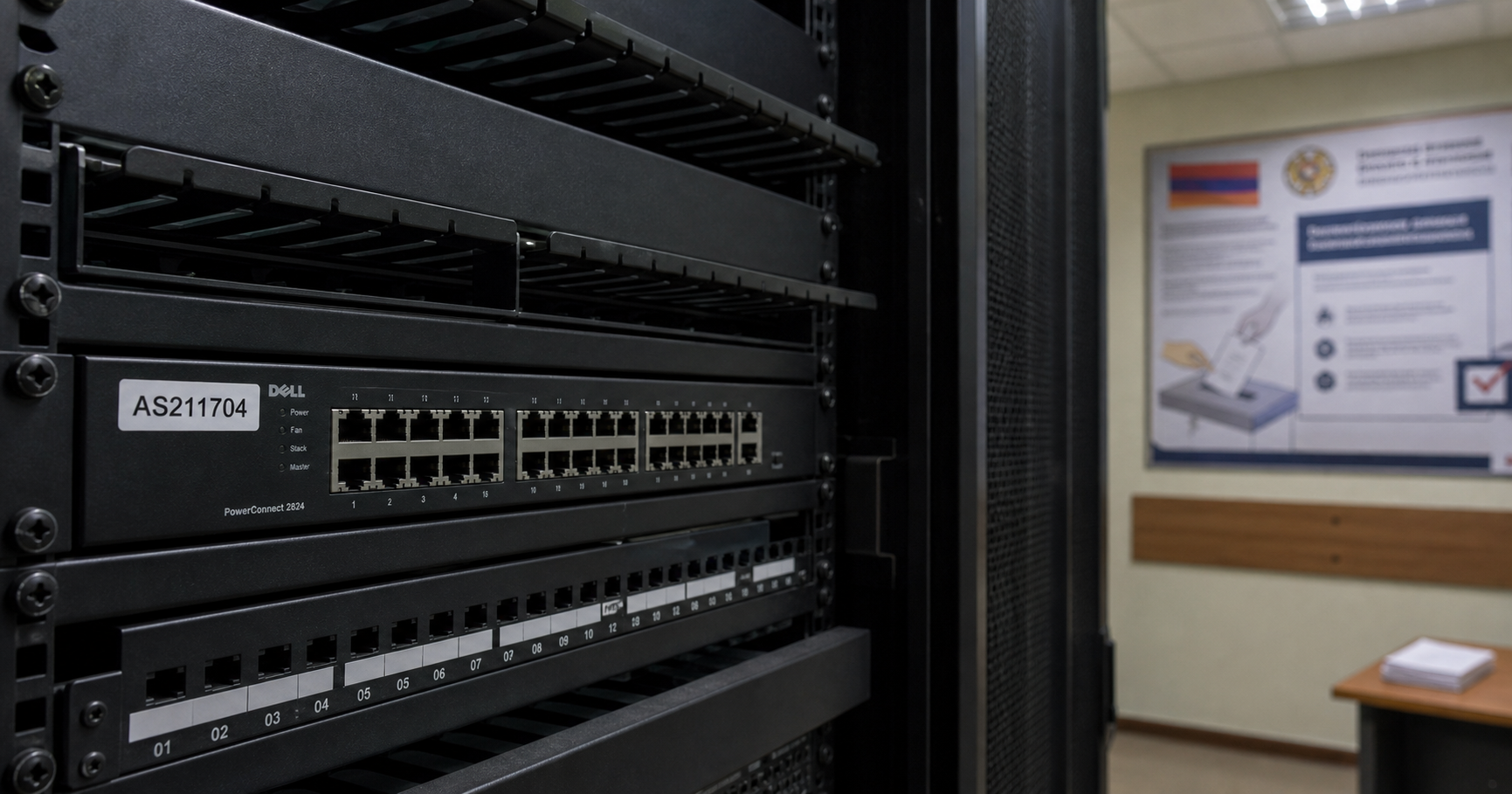
CEC-AM-AS CENTRAL ELECTORAL COMMISION OF THE REPUBLIC OF ARMENIA holds AS211704 in RIPE NCC with zero announced prefixes. All evidence is limited to three registry sources, confirming only identity and dormancy. No operational network services, personnel, or internal architecture are known. The thesis is that a latent routing capability at a national electoral body creates a low-probability but high-impact watchpoint, especially if the AS ever becomes active. Uncertainty is high around intent, control, and even whether the resource is actively managed. Watch for first prefix announcements, registry contact shifts, and BGP peer emergence.
The commission participates in global internet number resource management as the holder of AS211704, a single autonomous system record. Its operational role is limited to registry participation; no active public internet services, hosting, or peering arrangements are evident. The AS likely underpins internal government network functions or represents a preparatory allocation, but the commission’s public internet footprint is nonexistent.
The AS registration grants the electoral commission a latent ability to originate BGP routes, which could be activated to influence traffic flows to or from election systems. Because the commission administers national voting, any routing capability introduces a watchpoint for potential monitoring, filtering, or isolation of political data traffic. The current absence of announcements keeps this concern theoretical, yet the electoral mission makes even a dormant resource strategically sensitive.
The AS registration grants the electoral commission a latent ability to originate BGP routes, which could be activated to influence traffic flows to or from election systems. Because the commission administers national voting, any routing capability introduces a watchpoint for potential monitoring, filtering, or isolation of political data traffic. The current absence of announcements keeps this concern theoretical, yet the electoral mission makes even a dormant resource strategically sensitive.
The commission participates in global internet number resource management as the holder of AS211704, a single autonomous system record. Its operational role is limited to registry participation; no active public internet services, hosting, or peering arrangements are evident. The AS likely underpins internal government network functions or represents a preparatory allocation, but the commission’s public internet footprint is nonexistent.
If the commission were to announce IP prefixes and establish peering, it could alter routing paths for those addresses, potentially enabling interception, denial of service, or targeted monitoring of online election services. For now, the lack of observed announcements confines the impact to a latent possibility. Activation would require reassessment of the entity’s ability to affect the integrity or availability of Armenia’s electoral digital infrastructure.
CEC-AM-AS CENTRAL ELECTORAL COMMISION OF THE REPUBLIC OF ARMENIA holds AS211704 in RIPE NCC with zero announced prefixes. All evidence is limited to three registry sources, confirming only identity and dormancy. No operational network services, personnel, or internal architecture are known. The thesis is that a latent routing capability at a national electoral body creates a low-probability but high-impact watchpoint, especially if the AS ever becomes active. Uncertainty is high around intent, control, and even whether the resource is actively managed. Watch for first prefix announcements, registry contact shifts, and BGP peer emergence.
If the commission were to announce IP prefixes and establish peering, it could alter routing paths for those addresses, potentially enabling interception, denial of service, or targeted monitoring of online election services. For now, the lack of observed announcements confines the impact to a latent possibility. Activation would require reassessment of the entity’s ability to affect the integrity or availability of Armenia’s electoral digital infrastructure.
| 0.90–1.00 | A | High — direct sources |
| 0.75–0.89 | A/B | Strong |
| 0.55–0.74 | B/C | Medium |
| 0.35–0.54 | C/D | Weak–medium |
| 0.10–0.34 | D | Weak signal |
| 0.00–0.09 | D | Internal monitoring |
Several public sources
COMMISSION ÉLECTORALE CENTRALE DE LA RÉPUBLIQUE D'ARMÉNIE (CEC-AM-AS)
La Commission électorale centrale d'Arménie détient un numéro de système autonome dormant (AS211704) dans le registre internet RIPE NCC. Malgré sa présence dans le registre, aucun préfixe IP n'est annoncé, laissant la commission sans empreinte internet publique. Cette capacité de routage latente, si elle était activée, pourrait influencer les flux de trafic liés aux élections, faisant de cette ressource un point de surveillance stratégique.
Pourquoi c'est important
Si la commission venait à annoncer des préfixes IP et à établir des peering, elle pourrait modifier les chemins de routage pour ces adresses, permettant potentiellement l'interception, le déni de service ou la surveillance ciblée des services électoraux en ligne. Pour l'instant, l'absence d'annonces observées limite l'impact à une possibilité latente. Une activation nécessiterait une réévaluation de la capacité de l'entité à affecter l'intégrité ou la disponibilité de l'infrastructure numérique électorale de l'Arménie.
Ce que montrent les sources publiques
La Commission électorale centrale d'Arménie possède un numéro de système autonome — AS211704 — dans le registre internet mondial, mais elle n'a jamais annoncé un seul préfixe IP. L'enregistrement crée une capacité de routage dormante qui, si elle était activée, pourrait rediriger ou surveiller le trafic lié aux élections, faisant de la ressource un point de surveillance stratégique pour l'intégrité électorale. Aucun service internet public ni personnel n'est associé à ce numéro. Voir aussi: VoltzzNode Enterprise SRL.
Les preuves se composent de trois enregistrements officiels du RIPE NCC. L'aperçu du système autonome (stat.ripe.net) répertorie la commission comme détenteur en Arménie. Une requête RDAP confirme les détails d'enregistrement, et le point de terminaison des préfixes annoncés montre zéro origine IPv4 ou IPv6. L'empreinte du registre se limite à cette entrée dormante; aucune empreinte réseau opérationnelle n'est visible. Voir aussi: mioso Verwaltungs GmbH.
La surface de contrôle de la commission est la capacité d'originer des annonces BGP depuis AS211704 via son LIR parrain. Actuellement, cette surface est inactive. Il n'y a pas de pairs BGP publics, aucun préfixe routé et aucun trafic internet observable associé à ce système autonome. Son existence se limite à un enregistrement de registre. Voir aussi: GLOBALTRUST SRL.
Si la commission commençait un jour à annoncer des préfixes, elle pourrait influencer les chemins de routage internet pour ces espaces IP. Dans un contexte électoral gouvernemental, un tel contrôle pourrait permettre l'interception de données liées au vote, des attaques par déni de service contre les sites web électoraux ou un filtrage sélectif du contenu politique. À l'heure actuelle, l'impact est purement latent. Voir aussi: Pronect Technology LTD.
Surveillez la première annonce de préfixe depuis AS211704. Tout changement dans les contacts RIPE NCC ou l'apparition de pairs BGP signalerait que le système autonome passe de dormant à opérationnel. L'activation de cette ressource pendant un cycle électoral serait un événement de haute importance. La surveillance des flux BGP et des mises à jour du registre est la tâche de renseignement principale. Voir aussi: Alexis Lurot.
Une incertitude significative entoure l'architecture réseau interne de la commission. On ignore si le système autonome est connecté à des fournisseurs en amont, utilisé en interne ou simplement une allocation abandonnée. Aucun contact technique ou administratif n'est identifié dans les registres publics. Les raisons de l'acquisition du système autonome et la date d'enregistrement sont également absentes des preuves examinées. Voir aussi: PG Software Technologies SRL.
Surface opérationnelle
La commission participe à la gestion mondiale des ressources de numéros internet en tant que détenteur de AS211704, un enregistrement de système autonome unique. Son rôle opérationnel se limite à la participation au registre; aucun service internet public actif, hébergement ou accord de peering n'est évident. Le système autonome sous-tend probablement des fonctions réseau internes du gouvernement ou représente une allocation préparatoire, mais l'empreinte internet publique de la commission est inexistante.
L'enregistrement du système autonome confère à la commission électorale une capacité latente d'originer des routes BGP, qui pourrait être activée pour influencer les flux de trafic vers ou depuis les systèmes électoraux. Parce que la commission administre le vote national, toute capacité de routage introduit un point de surveillance pour la surveillance, le filtrage ou l'isolement potentiel du trafic de données politiques. L'absence actuelle d'annonces maintient cette préoccupation au niveau théorique, mais la mission électorale rend même une ressource dormante stratégiquement sensible.
Points de surveillance
Le système autonome dormant représente un point de contrôle d'infrastructure à faible probabilité mais à fort impact pour les systèmes électoraux nationaux. L'activation pourrait signaler une intention de gérer, filtrer ou surveiller le trafic internet lié aux élections. L'absence de preuves opérationnelles et de contacts identifiables accroît l'incertitude stratégique. Il s'agit d'un profil classique de signal de registre où la valeur de renseignement réside dans la surveillance des changements plutôt que dans les opérations actuelles.
Les points de surveillance observables concrets incluent: la première annonce BGP depuis AS211704; l'ajout d'un préfixe IPv4 ou IPv6 dans le registre RIPE NCC; les changements de contacts techniques ou administratifs; l'apparition de pairs BGP dans les tables de routage; tout site web public ou service en ligne lié à la commission qui utilise ce système autonome.
Aucune information sur l'architecture réseau interne, le peering ou les fournisseurs en amont. Aucun site web public, aucun contact personnel. Aucune donnée de routage historique. La date d'enregistrement et la raison de l'acquisition du système autonome sont inconnues. Des faits supplémentaires étayés par des sources sur ces points clarifieraient si le système autonome est activement géré ou abandonné.
Sources
- Enregistrement du registre internet - Soutient l'identité et le contexte de registre de la commission en tant que détenteur de AS211704 sans annonces actives.
- Enregistrement RDAP / WHOIS du registre - Confirme les détails d'enregistrement de AS211704 et le nom de l'entité dans le registre RIPE NCC.
- Enregistrement du registre internet - Montre qu'aucun préfixe IPv4 ou IPv6 n'est actuellement annoncé par AS211704, confirmant son statut de routage dormant.
Domain of operation
The Central Electoral Commission of Armenia holds a dormant autonomous system number (AS211704) in the RIPE NCC internet registry. Despite its registry presence, no IP prefixes are announced, leaving the commission without a public internet footprint. This latent routing capability, if ever activated, could influence election-related traffic flows, making the resource a strategic watchpoint.
- Internet registry record: Supports the identity and registry context of the commission as the holder of AS211704 with no active announcements. Evidence basis: source-3f516434474b
Timeline
- CEC-AM-AS CENTRAL ELECTORAL COMMISION OF THE REPUBLIC OF ARMENIA public evidence observed
The AS registration grants the electoral commission a latent ability to originate BGP routes, which could be activated to influence traffic flows to or from election systems. Because the commission administers national voting, any routing capability introduces a watchpoint for potential monitoring, filtering, or isolation of political data traffic. The current absence of announcements keeps this concern theoretical, yet the electoral mission makes even a dormant resource strategically sensitive.
En bref
- Nom: CEC-AM-AS CENTRAL ELECTORAL COMMISION OF THE REPUBLIC OF ARMENIA
- Type: Digital infrastructure institution
- Base: Armenia
- Axe du profil: Institution
Ce que cela fait
- public operating records
- official service pages
- documented relationships updates
Pourquoi c'est important
- If the commission were to announce IP prefixes and establish peering, it could alter routing paths for those addresses, potentially enabling interception, denial of service, or targeted monitoring of online election services. For now, the lack of observed announcements confines the impact to a latent possibility. Activation would require reassessment of the entity’s ability to affect the integrity or availability of Armenia’s electoral digital infrastructure.
- Criticité opérationnelle: Medium
- Horizon: Next quarter
À surveiller
- official company sources
- public registries
- operator-published records
Suivre les mises à jour de sources vérifiées, les changements de rôle et les preuves publiques actuelles.
If the commission were to announce IP prefixes and establish peering, it could alter routing paths for those addresses, potentially enabling interception, denial of service, or targeted monitoring of online election services. For now, the lack of observed announcements confines the impact to a latent possibility. Activation would require reassessment of the entity’s ability to affect the integrity or availability of Armenia’s electoral digital infrastructure.
La pertinence de long terme dépend de changements vérifiés dans l'exploitation, les politiques et les relations.
Member Briefing
Deeper Profile Context
Login is required to unlock the full profile briefing and source notes.
Only for Strategy Circle
Strategic Circle Access
Open to all readers. Unlock profile briefings after joining and logging in.
Join Strategic CircleOnly for Leadership Alliance
Leadership Alliance Access
For owners and management of IP-holding companies. Login required to unlock.
Join Leadership AlliancePublic View
If the commission were to announce IP prefixes and establish peering, it could alter routing paths for those addresses, potentially enabling interception, denial of service, or targeted monitoring of online election services. For now, the lack of observed announcements confines the impact to a latent possibility. Activation would require reassessment of the entity’s ability to affect the integrity or availability of Armenia’s electoral digital infrastructure.
Watchpoints
- The dormant AS represents a low-likelihood but high-impact infrastructure control point for national election systems.
- Activation could signal an intent to manage, filter, or monitor election-related internet traffic.
- The lack of any operational evidence and absence of identifiable contacts heightens the strategic uncertainty.
Caveats
- Public evidence is used only for source-backed claims.
- Private control or contract claims require separate public support.
FAQ
Why does BTW track CEC-AM-AS CENTRAL ELECTORAL COMMISION OF THE REPUBLIC OF ARMENIA?
The AS registration grants the electoral commission a latent ability to originate BGP routes, which could be activated to influence traffic flows to or from election systems. Because the commission administers national voting, any routing capability introduces a watchpoint for potential monitoring, filtering, or isolation of political data traffic. The current absence of announcements keeps this concern theoretical, yet the electoral mission makes even a dormant resource strategically sensitive.
What evidence supports the profile?
Supports the identity and registry context of the commission as the holder of AS211704 with no active announcements.
What should readers watch next?
The dormant AS represents a low-likelihood but high-impact infrastructure control point for national election systems.