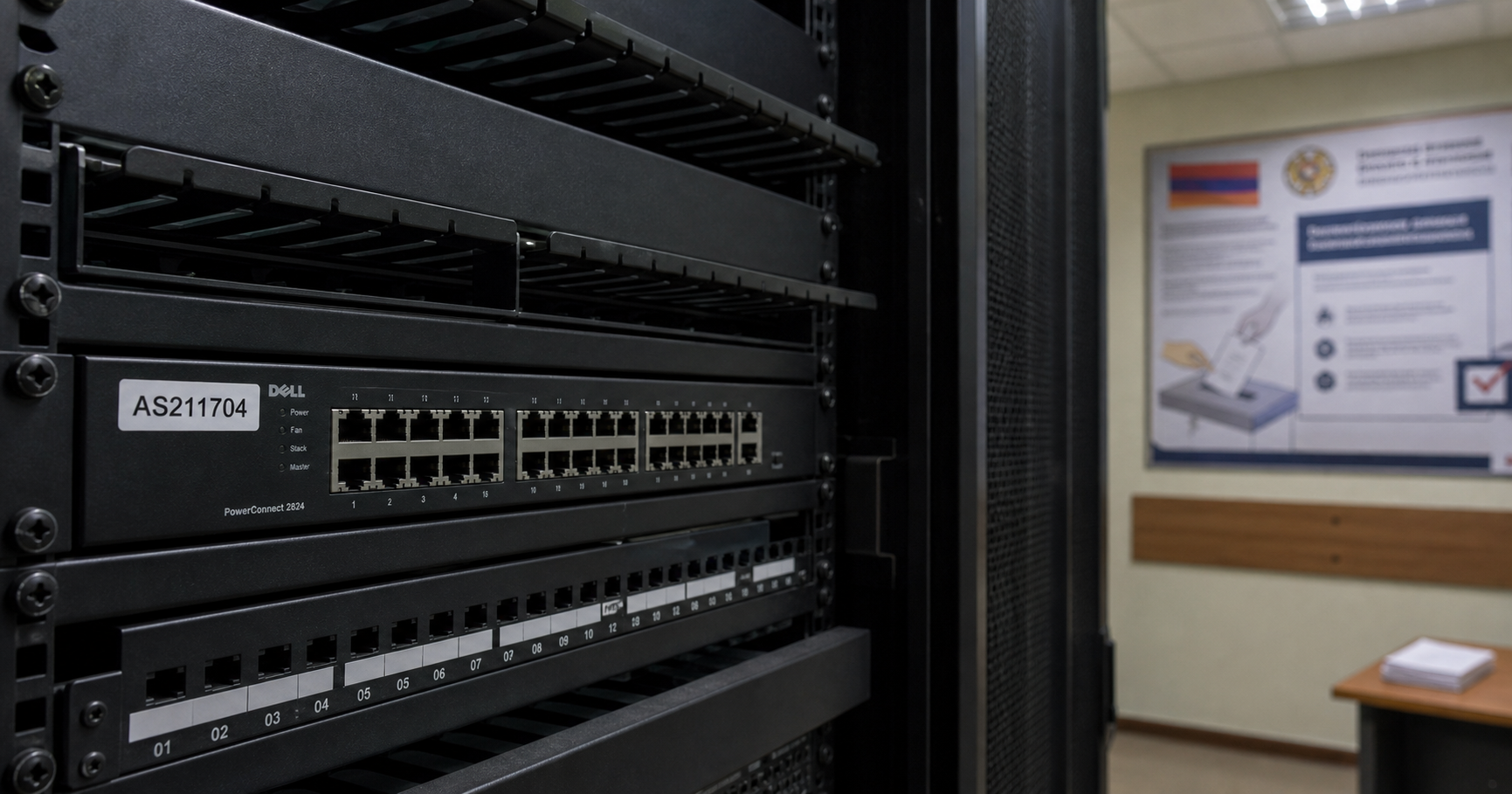
CEC-AM-AS CENTRAL ELECTORAL COMMISION OF THE REPUBLIC OF ARMENIA holds AS211704 in RIPE NCC with zero announced prefixes. All evidence is limited to three registry sources, confirming only identity and dormancy. No operational network services, personnel, or internal architecture are known. The thesis is that a latent routing capability at a national electoral body creates a low-probability but high-impact watchpoint, especially if the AS ever becomes active. Uncertainty is high around intent, control, and even whether the resource is actively managed. Watch for first prefix announcements, registry contact shifts, and BGP peer emergence.
The commission participates in global internet number resource management as the holder of AS211704, a single autonomous system record. Its operational role is limited to registry participation; no active public internet services, hosting, or peering arrangements are evident. The AS likely underpins internal government network functions or represents a preparatory allocation, but the commission’s public internet footprint is nonexistent.
The AS registration grants the electoral commission a latent ability to originate BGP routes, which could be activated to influence traffic flows to or from election systems. Because the commission administers national voting, any routing capability introduces a watchpoint for potential monitoring, filtering, or isolation of political data traffic. The current absence of announcements keeps this concern theoretical, yet the electoral mission makes even a dormant resource strategically sensitive.
The AS registration grants the electoral commission a latent ability to originate BGP routes, which could be activated to influence traffic flows to or from election systems. Because the commission administers national voting, any routing capability introduces a watchpoint for potential monitoring, filtering, or isolation of political data traffic. The current absence of announcements keeps this concern theoretical, yet the electoral mission makes even a dormant resource strategically sensitive.
The commission participates in global internet number resource management as the holder of AS211704, a single autonomous system record. Its operational role is limited to registry participation; no active public internet services, hosting, or peering arrangements are evident. The AS likely underpins internal government network functions or represents a preparatory allocation, but the commission’s public internet footprint is nonexistent.
If the commission were to announce IP prefixes and establish peering, it could alter routing paths for those addresses, potentially enabling interception, denial of service, or targeted monitoring of online election services. For now, the lack of observed announcements confines the impact to a latent possibility. Activation would require reassessment of the entity’s ability to affect the integrity or availability of Armenia’s electoral digital infrastructure.
CEC-AM-AS CENTRAL ELECTORAL COMMISION OF THE REPUBLIC OF ARMENIA holds AS211704 in RIPE NCC with zero announced prefixes. All evidence is limited to three registry sources, confirming only identity and dormancy. No operational network services, personnel, or internal architecture are known. The thesis is that a latent routing capability at a national electoral body creates a low-probability but high-impact watchpoint, especially if the AS ever becomes active. Uncertainty is high around intent, control, and even whether the resource is actively managed. Watch for first prefix announcements, registry contact shifts, and BGP peer emergence.
If the commission were to announce IP prefixes and establish peering, it could alter routing paths for those addresses, potentially enabling interception, denial of service, or targeted monitoring of online election services. For now, the lack of observed announcements confines the impact to a latent possibility. Activation would require reassessment of the entity’s ability to affect the integrity or availability of Armenia’s electoral digital infrastructure.
| 0.90–1.00 | A | High — direct sources |
| 0.75–0.89 | A/B | Strong |
| 0.55–0.74 | B/C | Medium |
| 0.35–0.54 | C/D | Weak–medium |
| 0.10–0.34 | D | Weak signal |
| 0.00–0.09 | D | Internal monitoring |
Several public sources
CEC-AM-AS COMISIÓN ELECTORAL CENTRAL DE LA REPÚBLICA DE ARMENIA
La Comisión Electoral Central de Armenia posee un número de sistema autónomo inactivo (AS211704) en el registro de internet de RIPE NCC. A pesar de su presencia en el registro, no se anuncian prefijos IP, lo que deja a la comisión sin una huella pública en internet. Esta capacidad de enrutamiento latente, si alguna vez se activa, podría influir en los flujos de tráfico relacionados con las elecciones, convirtiendo el recurso en un punto de vigilancia estratégico.
Por Qué Es Importante
Si la comisión llegara a anunciar prefijos IP y establecer peering, podría alterar las rutas de enrutamiento para esas direcciones, lo que podría permitir la interceptación, denegación de servicio o monitoreo dirigido de los servicios electorales en línea. Por ahora, la falta de anuncios observados limita el impacto a una posibilidad latente. La activación requeriría una reevaluación de la capacidad de la entidad para afectar la integridad o disponibilidad de la infraestructura digital electoral de Armenia. Ver también: CEC-AM-AS CENTRAL ELECTORAL COMMISION OF THE REPUBLIC OF ARMENIA.
Lo Que Muestran las Fuentes Públicas
La Comisión Electoral Central de Armenia posee un número de sistema autónomo—AS211704—en el registro global de internet, pero nunca ha anunciado un solo prefijo IP. El registro crea una capacidad de enrutamiento inactiva que, si se activa, podría redirigir o monitorear el tráfico relacionado con las elecciones, convirtiendo el recurso en un punto de vigilancia estratégico para la integridad electoral. No hay servicios públicos de internet ni personal vinculado a este número. Ver también: VoltzzNode Enterprise SRL.
La evidencia consiste en tres registros oficiales de RIPE NCC. La descripción general del AS (stat.ripe.net) enumera a la comisión como titular en Armenia. Una consulta RDAP confirma los detalles de registro, y el endpoint de prefijos anunciados muestra cero orígenes IPv4 o IPv6. La huella en el registro se limita a esta entrada inactiva; no se observa ninguna huella de red operativa. Ver también: mioso Verwaltungs GmbH.
La superficie de control de la comisión es la capacidad de originar anuncios BGP desde AS211704 a través de su LIR patrocinador. Actualmente, esa superficie está inactiva. No hay peers BGP públicos, prefijos enrutados ni tráfico de internet observable asociado a este AS. Su única existencia es como registro en el registro. Ver también: GLOBALTRUST SRL.
Si la comisión alguna vez comenzara a anunciar prefijos, podría influir en las rutas de enrutamiento de internet para esos espacios de IP. En un contexto electoral gubernamental, dicho control podría permitir la interceptación de datos relacionados con el voto, la denegación de servicio contra sitios web electorales o el filtrado selectivo de contenido político. En la actualidad, el impacto es puramente latente. Ver también: Pronect Technology LTD.
Esté atento al primer anuncio de prefijo desde AS211704. Cualquier cambio en los contactos de RIPE NCC o la aparición de peers BGP indicaría que el AS está pasando de inactivo a operativo. La activación de este recurso durante un ciclo electoral sería un evento de alta importancia. Monitorear las fuentes BGP y las actualizaciones del registro es la principal tarea de inteligencia. Ver también: Alexis Lurot.
Existe una incertidumbre significativa en torno a la arquitectura de red interna de la comisión. Se desconoce si el AS está conectado a proveedores upstream, se utiliza internamente o es simplemente una asignación abandonada. No se identifican contactos técnicos ni administrativos en los registros públicos. Los motivos para adquirir el AS y la fecha de registro también están ausentes de la evidencia examinada. Ver también: PG Software Technologies SRL.
Superficie Operativa
La comisión participa en la gestión global de recursos de numeración de internet como titular de AS211704, un único registro de sistema autónomo. Su función operativa se limita a la participación en el registro; no hay evidencia de servicios públicos de internet activos, alojamiento o acuerdos de peering. Es probable que el AS sirva de base para funciones de red gubernamentales internas o represente una asignación preparatoria, pero la huella pública de internet de la comisión es inexistente.
El registro del AS otorga a la comisión electoral la capacidad latente de originar rutas BGP, que podrían ser activadas para influir en los flujos de tráfico hacia o desde los sistemas electorales. Dado que la comisión administra las votaciones nacionales, cualquier capacidad de enrutamiento constituye un punto de vigilancia para el posible monitoreo, filtrado o aislamiento del tráfico de datos políticos. Actualmente, la falta de anuncios mantiene esta preocupación en el plano teórico, aunque la misión electoral hace que incluso un recurso inactivo sea estratégicamente sensible.
Puntos de Vigilancia
El AS inactivo representa un punto de control de infraestructura de baja probabilidad pero alto impacto para los sistemas electorales nacionales. La activación podría indicar la intención de gestionar, filtrar o monitorear el tráfico de internet relacionado con las elecciones. La falta de evidencia operativa y la ausencia de contactos identificables aumentan la incertidumbre estratégica. Este es un perfil clásico de señal de registro donde el valor de inteligencia radica en monitorear los cambios en lugar de las operaciones actuales.
Los puntos de vigilancia observables concretos incluyen: el primer anuncio BGP desde AS211704; la adición de un prefijo IPv4 o IPv6 en el registro RIPE NCC; cambios en los contactos técnicos o administrativos; la aparición de peers BGP en las tablas de enrutamiento; cualquier sitio web público o servicio en línea vinculado a la comisión que utilice este AS.
No hay información sobre la arquitectura de red interna, peering o proveedores upstream. No hay sitio web público, ni contactos de personal. No hay datos históricos de enrutamiento. Se desconocen la fecha de registro y el motivo de la adquisición del AS. Datos adicionales respaldados por fuentes sobre estos puntos aclararían si el AS se gestiona activamente o está abandonado.
Fuentes
- Registro de internet - Respalda la identidad y el contexto de registro de la comisión como titular de AS211704 sin anuncios activos.
- Registro RDAP/WHOIS - Confirma los detalles de registro de AS211704 y el nombre de la entidad en el registro RIPE NCC.
- Registro de internet - Muestra que actualmente no se anuncian prefijos IPv4 o IPv6 desde AS211704, confirmando su estado de enrutamiento inactivo.
Domain of operation
The Central Electoral Commission of Armenia holds a dormant autonomous system number (AS211704) in the RIPE NCC internet registry. Despite its registry presence, no IP prefixes are announced, leaving the commission without a public internet footprint. This latent routing capability, if ever activated, could influence election-related traffic flows, making the resource a strategic watchpoint.
- Internet registry record: Supports the identity and registry context of the commission as the holder of AS211704 with no active announcements. Evidence basis: source-3f516434474b
Timeline
- CEC-AM-AS CENTRAL ELECTORAL COMMISION OF THE REPUBLIC OF ARMENIA public evidence observed
The AS registration grants the electoral commission a latent ability to originate BGP routes, which could be activated to influence traffic flows to or from election systems. Because the commission administers national voting, any routing capability introduces a watchpoint for potential monitoring, filtering, or isolation of political data traffic. The current absence of announcements keeps this concern theoretical, yet the electoral mission makes even a dormant resource strategically sensitive.
At A Glance
- Name: CEC-AM-AS CENTRAL ELECTORAL COMMISION OF THE REPUBLIC OF ARMENIA
- Type: Digital infrastructure institution
- Base: Armenia
- Profile focus: Institution
What It Does
- public operating records
- official service pages
- documented relationships updates
Why It Matters
- If the commission were to announce IP prefixes and establish peering, it could alter routing paths for those addresses, potentially enabling interception, denial of service, or targeted monitoring of online election services. For now, the lack of observed announcements confines the impact to a latent possibility. Activation would require reassessment of the entity’s ability to affect the integrity or availability of Armenia’s electoral digital infrastructure.
- Operational criticality: Medium
- Time horizon: Next quarter
What To Watch
- official company sources
- public registries
- operator-published records
Track verified source updates, role changes, and current public evidence.
If the commission were to announce IP prefixes and establish peering, it could alter routing paths for those addresses, potentially enabling interception, denial of service, or targeted monitoring of online election services. For now, the lack of observed announcements confines the impact to a latent possibility. Activation would require reassessment of the entity’s ability to affect the integrity or availability of Armenia’s electoral digital infrastructure.
Longer-term relevance depends on verified operating, policy, and relationship changes.
Member Briefing
Deeper Profile Context
Login is required to unlock the full profile briefing and source notes.
Only for Strategy Circle
Strategic Circle Access
Open to all readers. Unlock profile briefings after joining and logging in.
Join Strategic CircleOnly for Leadership Alliance
Leadership Alliance Access
For owners and management of IP-holding companies. Login required to unlock.
Join Leadership AlliancePublic View
If the commission were to announce IP prefixes and establish peering, it could alter routing paths for those addresses, potentially enabling interception, denial of service, or targeted monitoring of online election services. For now, the lack of observed announcements confines the impact to a latent possibility. Activation would require reassessment of the entity’s ability to affect the integrity or availability of Armenia’s electoral digital infrastructure.
Watchpoints
- The dormant AS represents a low-likelihood but high-impact infrastructure control point for national election systems.
- Activation could signal an intent to manage, filter, or monitor election-related internet traffic.
- The lack of any operational evidence and absence of identifiable contacts heightens the strategic uncertainty.
Caveats
- Public evidence is used only for source-backed claims.
- Private control or contract claims require separate public support.
FAQ
Why does BTW track CEC-AM-AS CENTRAL ELECTORAL COMMISION OF THE REPUBLIC OF ARMENIA?
The AS registration grants the electoral commission a latent ability to originate BGP routes, which could be activated to influence traffic flows to or from election systems. Because the commission administers national voting, any routing capability introduces a watchpoint for potential monitoring, filtering, or isolation of political data traffic. The current absence of announcements keeps this concern theoretical, yet the electoral mission makes even a dormant resource strategically sensitive.
What evidence supports the profile?
Supports the identity and registry context of the commission as the holder of AS211704 with no active announcements.
What should readers watch next?
The dormant AS represents a low-likelihood but high-impact infrastructure control point for national election systems.