CAIGA is not reform, it is a rewrite of who controls Africa’s internet is tracked as a internet infrastructure institution within the internet infrastructure ecosystem.
CAIGA is not reform, it is a rewrite of who controls Africa’s internet has public-source relevance to network operations, governance, dependency mapping, or market structure.
CAIGA is not reform, it is a rewrite of who controls Africa’s internet has public-source relevance to network operations, governance, dependency mapping, or market structure.
CAIGA is not reform, it is a rewrite of who controls Africa’s internet is tracked as a internet infrastructure institution within the internet infrastructure ecosystem.
Public-source signals support medium-impact monitoring for infrastructure visibility and dependency analysis.
Public-source signals support medium-impact monitoring for infrastructure visibility and dependency analysis.
| 0.90–1.00 | A | High — direct sources |
| 0.75–0.89 | A/B | Strong |
| 0.55–0.74 | B/C | Medium |
| 0.35–0.54 | C/D | Weak–medium |
| 0.10–0.34 | D | Weak signal |
| 0.00–0.09 | D | Internal monitoring |
Several public sources
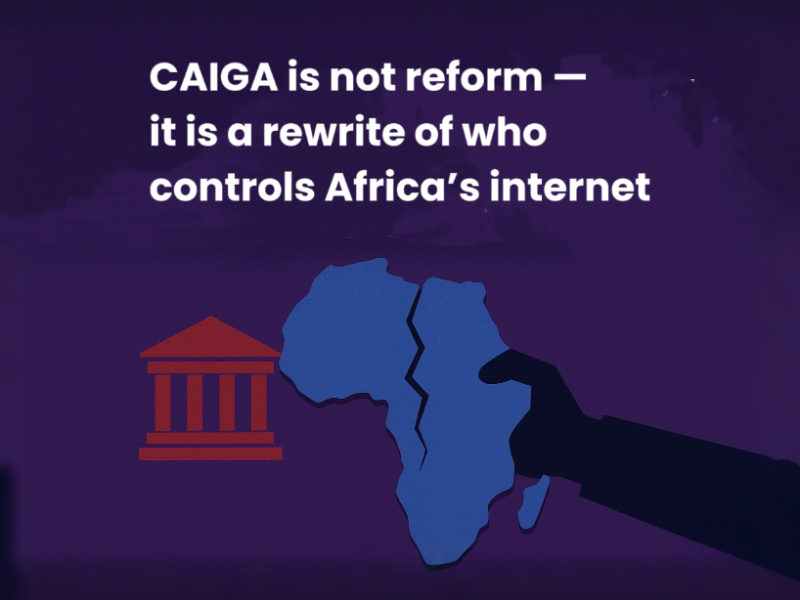
- CAIGA has exposed deep fractures within Africa’s internet community, as many question whether it represents reform or a political takeover.
- Critics argue Smart Africa and ICANN are accelerating governance instability by promoting a state-centric model during AFRINIC’s weakest moment.
A crisis creates space for competing agendas
Africa’s internet governance ecosystem is at a critical juncture. AFRINIC, the continent’s Regional Internet Registry, has suffered years of institutional failure—governance paralysis, contested elections, legal battles and a steady erosion of community trust. Into this vacuum has stepped the Continental Africa Internet Governance Architecture (CAIGA), an initiative closely associated with Smart Africa and developed with ICANN’s financial and institutional involvement.
This moment of collapse has polarised stakeholders. Some see CAIGA as an unavoidable intervention following AFRINIC’s breakdown. Others view it as an opportunistic power grab, exploiting institutional weakness to introduce a political governance layer that would permanently reshape Africa’s internet oversight.
The divide is not about whether AFRINIC has failed—few dispute that—but about what should replace it. See also: AfriNIC board faces legitimacy test.
Also Read: Will CAIGA Improve Cross-Border Internet Cooperation?
Community governance versus political authority
At the heart of the disagreement lies a fundamental clash of governance models. Africa’s internet has historically been managed through bottom-up, multistakeholder processes, where operators, engineers and civil society share authority. CAIGA proposes something markedly different: a centralised architecture in which governments play a dominant role, with political endorsement mechanisms sitting above community processes. See also: AfriNIC board: The Eight Who Govern Africa’s Internet.
Critics warn this shift marginalises the very communities that have kept Africa’s internet functioning despite AFRINIC’s failures. They argue CAIGA replaces accountability with hierarchy, and technical consensus with political alignment. Rather than repairing governance, CAIGA risks institutionalising the same opacity and capture that undermined AFRINIC—only on a continental scale See also: AfriNIC's Vanishing Member register.
Also Read: CAIGA’s arrival: A threat to Africa’s multistakeholder governance
ICANN’s involvement intensifies distrust
ICANN’s role has further deepened divisions. The organisation has funded and participated in the development of Smart Africa’s governance blueprint, despite publicly claiming neutrality. Milton Mueller at the Internet Governance Project argue this contradicts ICANN’s long-standing commitment to bottom-up governance and creates a dangerous double standard for Africa.
Stakeholders ask why a state-centric governance experiment is being enabled in Africa when similar models would be rejected elsewhere. Until those questions are answered, CAIGA will remain a source of division—less a solution to Africa’s governance crisis than a catalyst for deeper conflict over autonomy, accountability and control. See also: AFRINIC crisis: when receiver becomes legal risk.
Domain of operation
CAIGA is not reform, it is a rewrite of who controls Africa’s internet is profiled by BTW Media because published evidence links it to internet infrastructure, governance, operational dependencies, or market visibility.
- Public role: CAIGA is not reform, it is a rewrite of who controls Africa’s internet is framed by caiga is not reform, it is a rewrite of who controls africa’s internet is tracked as a internet infrastructure institution within the internet infrastructure ecosystem. and public governance context. Evidence basis: CAIGA is not reform, it is a rewrite of who controls Africa’s internet article record; CAIGA is not reform, it is a rewrite of who controls Africa’s internet article record
- Operating surface: Governance and Africa provide the public context for this institution profile. Evidence basis: CAIGA is not reform, it is a rewrite of who controls Africa’s internet article record; CAIGA is not reform, it is a rewrite of who controls Africa’s internet article record
Timeline
- CAIGA is not reform, it is a rewrite of who controls Africa’s internet public profile updated
Public coverage records CAIGA is not reform, it is a rewrite of who controls Africa’s internet as a subject for role, operating context, and evidence review.
At A Glance
- Name: CAIGA is not reform, it is a rewrite of who controls Africa’s internet
- Type: Internet infrastructure institution
- Base: Africa
- Profile focus: Institution
What It Does
- Public records support monitoring of its role, services, and key relationships.
Why it matters
- Public-source signals support medium-impact monitoring for infrastructure visibility and dependency analysis.
- Operational criticality: Medium
- Time Horizon: Next quarter
What To Watch
- Monitoring focuses on verified service continuity, governance changes, and relationship signals.
Track verified source updates, role changes, and current public evidence.
Public-source signals support medium-impact monitoring for infrastructure visibility and dependency analysis.
Longer-term relevance depends on verified operating, policy, and relationship changes.
Member Briefing
Deeper Profile Context
Sign in to unlock the full profile briefing and source notes.
Only for Strategic Circle
Strategic Circle
Open to all readers. Unlock profile briefings after joining and signing in.
Join Strategic CircleOnly for Leadership Alliance
Leadership Alliance
For qualified IP-asset owners and management; sign in to unlock alliance briefings.
Join Leadership AlliancePublic View
The public read of CAIGA is not reform, it is a rewrite of who controls Africa’s internet is limited to visible role, operating context, and relationship evidence.
Watchpoints
- New public role, affiliation, product, policy, or market disclosures.
- Verified relationship changes involving named organizations or people.
Caveats
- Private or unverified claims are excluded from this public view.
FAQ
Why is CAIGA is not reform, it is a rewrite of who controls Africa’s internet included?
CAIGA is not reform, it is a rewrite of who controls Africa’s internet has public evidence that makes the institution relevant to BTW's coverage of digital infrastructure, governance, or markets.
What is public about this profile?
The public layer covers visible role, operating context, linked organizations, and evidence-backed watchpoints.
What should readers watch next?
Readers should watch for source-backed role changes, new partnerships, regulatory exposure, operating expansion, or evidence that changes the public assessment.