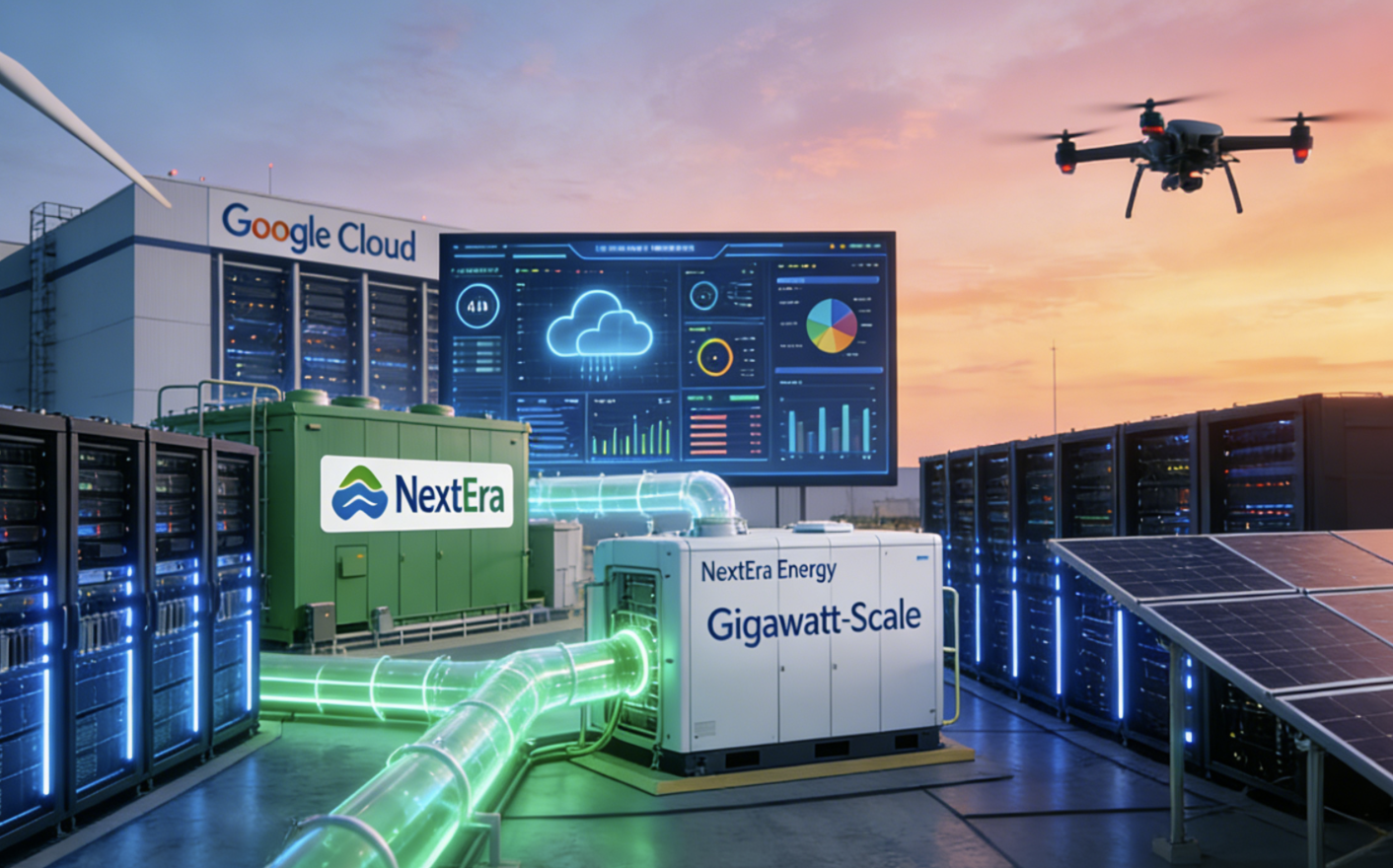
- The collaboration will deliver large-scale, integrated data-centre and power infrastructure, combining energy generation with AI-powered grid management.
- A new AI-enabled offering is expected in the Google Cloud Marketplace by mid-2026, promising predictive maintenance and enhanced grid resiliency.
What happened: A major expansion of a long-running energy–AI partnership
On 8 December 2025, NextEra Energy and Google Cloud announced a major scaling up of their long-time energy-technology collaboration. Under the agreement, the two companies will jointly develop multiple new gigawatt (GW)-scale data centre campuses across the United States, each accompanied by dedicated energy generation and capacity.
Google Cloud will also play a central role in NextEra’s enterprise-wide digital transformation, supplying advanced AI infrastructure and software to modernise operations and grid management.
As part of the deal, the companies plan to launch a commercial AI-powered product by mid-2026, to be offered via the Google Cloud Marketplace. The tool is designed to integrate generative and agent-style AI with NextEra’s operational data, enabling predictive maintenance, staff scheduling, supply-chain optimisation and proactive response to weather or other disruptions — a bid to keep power systems reliable and reduce running costs.
Beyond internal operations, Google Cloud’s time-series forecasting model, weather forecasting mode land advanced power-flow modelling will be deployed to improve grid resilience, particularly in the face of storm events, equipment ageing, and increased demand.
Strategically, the first three campuses are already under development, and the companies say they will continue working to identify additional sites and expand capacity further. The collaboration builds on an existing portfolio: the firms currently have around 3.5 GW of generation either operational or under contract.
Also read: Data centre power demand pushes NextEra to big quarter
Also read: OpenAI pitches White House on unprecedented data centre expansion
Why it’s important
The scale of this deal reflects a sharp recognition: as AI workloads surge, demand for energy — and stable, reliable grid infrastructure — is becoming a critical bottleneck. By coupling new data-centre capacity with dedicated generation and AI-driven management tools, NextEra and Google Cloud aim to manage that demand proactively.
If deployed successfully, the AI-enabled grid tools could reduce downtime, pre-empt outages, optimise crew- and resource-allocation, and in principle deliver cost savings — benefits that could reverberate across utilities serving millions.
Moreover, the strategy may signal a shift in how tech firms approach their infrastructure needs. Rather than simply buying power on wholesale markets, companies like Google may increasingly partner directly with energy providers — building end-to-end systems from generation to consumption. That could accelerate the adoption of renewables, storage, and grid modernisation.
However, questions remain. The firms have not disclosed the full scale of new generation capacity, or the exact energy mix (renewable, nuclear, gas) that will support the data centre campuses. There is also the broader challenge of ensuring that such AI-driven infrastructure expansion does not exacerbate overall fossil-fuel dependence or undermine climate goals.
Furthermore, the rush to scale data centres and energy infrastructure raises concerns about long-term energy demand and grid stability, especially if AI growth plateaus or shifts. Will these investments remain efficient and necessary — or become stranded infrastructure?
Finally, the introduction of AI risk-management tools brings potential trade-offs. While predictive maintenance and crew scheduling offer efficiency, they also raise questions about workforce displacement, data privacy, and reliance on automated decision-making at critical grid-management junctures.
This partnership, then should be viewed neither as a silver bullet nor a blanket good: it’s a significant experiment at the frontier of energy and AI, one whose success depends on transparent implementation, thoughtful environmental stewardship, and careful governance.