Lead Report / History

A cinematic brass-and-glass network chamber where matching native attachments flank a sparse transparent conduit; a blue service object and three amber attribute tokens cross a shared packet lattice while an optional transformation prism remains bypassed; no text, digits, logos, UI or people.
A buyer can sign for an “Ethernet circuit” and still leave the decisive term undefined: which attributes must survive for the packet-network emulation to count as the service that was ordered?

The Network Carried the Wire’s Essentials, Not the Wire Itself: RFC 3985

A buyer can sign for an “Ethernet circuit” and still leave the decisive term undefined: which attributes must survive for the packet-network emulation to count as the service that was ordered?

  1. Editorial illustration of flexible mining racks and a smaller GPU server room beside a utility substation; conceptual, not a photograph of PowerCompute’s Columbus facility.

    PowerCompute’s 11 MW contract firms only 300 kW at peak

    PowerCompute’s Columbus contract names 11 MW of off-peak firm demand and 300 kW of on-peak firm demand. The distinction favours a load that can step down when the tariff says “peak”; it does not by itself establish an 11 MW, around-the-clock power product for high-performance computing.

  2. Two provider-edge gateways exchange an Ethernet frame through a transparent pseudowire; its Root/Leaf role marker fades before the remote edge.

    The Frame Crossed the Pseudowire. Its Service Role Did Not: RFC 7152

    In 2014, an IETF requirements memo exposed a small but consequential gap in Layer 2 VPNs: a provider-edge router could receive an Ethernet frame across a pseudowire without knowing whether the frame had entered the remote network through a root or a leaf attachment. RFC 7152 turned that missing context into requirements for carrying an Ethernet Tree service across a multipoint network.

  3. Four legacy hosts retain individual IPv4 lease markers while ordinary off-link IPv4 paths stop, IPv6 routes continue, and one inbound signal remains.

    The Legacy Host Went Quiet. Its IPv4 Lease Did Not.

    A /32 DHCPv4 mask can quiet an old client that cannot use IPv6-Only Preferred. The address it receives, the inbound packets it can still accept and the pool that supplies its lease remain operational questions.

Member Access

Your daily intelligence edge starts here

Strategic Circle turns infrastructure moves, policy shifts and market signals into a concise briefing in your chosen language—plus the research library and member forum—for USD 20/month.

  • 01Daily intelligence brief
  • 02Governance + market + RIR
  • 03Preference control anytime

BTW Media on Air

Selected briefings, interviews, and live sessions from the BTW intelligence team, focused on internet infrastructure, governance, and market signals.

View All

Equifax Had the Patch. Why Did the Breach Last 76 Days?

23andMe: How 14,000 Accounts Exposed Millions

One 5G Slice Worked. Did the Whole Network Improve?

The GPU Price Was Exact. The Room Wasn’t Binding.

53% Cloud Revenue Does Not Mean Two Customers

Domo Has $410.8M in RPO. Why Debt Still Matters

UiPath’s $1.938B ARR Is Not Backlog

Two Tenants Signed. The Fibre Still Isn’t Built

The Fibre Was Cut. Backup Kept It Online—But Degraded

$6B Bought Land—Not Working Data Centres

7.48GW Is Being Built. Who Keeps It Running?

A $1.25B Lease ≠ a $1.25B Company

Celestica Revenue Jumped 62%. Why Sell 11.1M Shares?

Celestica Revenue Jumps 62%—What About Cash?

TLS Is Connected—Is the Device Still Trusted?

Editorial portrait of Rebecca MacKinnon in an illustrative digital-rights research setting.

Market

Rebecca MacKinnon’s Return Puts Two Accountability Methods in View

When Rebecca MacKinnon returned to the Global Network Initiative in August 2026, she brought a useful history into view: she helped found both GNI and Ranking Digital Rights, but the organizations examine accountability through different evidence. A 2020 RDR scoring rule treated company membership in GNI as only partial evidence for one disclosure element; GNI’s later assessment process examines internal systems and selected cases. Neither method answers every question about rights in practice.

Conceptual illustration of unbranded silicon design blocks moving from a blueprint across a wafer toward an unmarked production counter.

Market / Trends

Synopsys’s $1bn Amazon deal still needs a royalty meter

The multiyear agreement makes Amazon the lead customer for Synopsys’s application-optimized silicon IP, while also covering design software and Synopsys’s use of AWS. The economic test is how much of that relationship reaches production and becomes measurable royalties.

Several access links converge at a relay; amber markers continue along a translucent path toward server racks.

Governance

DHCP Carried a Stable Subscriber ID. The Standard Did Not Define Its Meaning: RFC 3993

A customer could move between access paths while a provider still wanted the same configuration decision. RFC 3993 gave the DHCP relay a place to carry a stable subscriber label, but left the label’s assignment and meaning with the provider.

Conceptual diagram of Cloudflare R2 object storage, an outward file-transfer route and a separate workspace for inspecting replacement application components.

Market / Companies

Cloudflare R2’s zero-egress price is not a zero-cost exit

Cloudflare lists no charge for outbound transfer from R2 and documents a way to copy objects out. The remaining economic question is what customers must spend—and successfully operate—to turn that export into a working replacement.

Three conference microphones stand apart from an organised production desk in a quiet Pokhara meeting room.

Governance / NOGS

Who opens the room? What npNOG-10's welcome order can—and cannot—prove

The first twenty minutes of a conference can reveal institutional relationships. They cannot, without supporting records, tell us who held the decisive authority.

Editorial position

Why BTW Media exists

  • Reality over advocacy
  • Evidence over sentiment
  • Systems over noise

Internet governance is too often described as theory, consensus, or institutional comfort while operators live with the consequences of structure, scarcity, jurisdiction, and incentives.

BTW shows how the system works when assumptions are tested: clear, uncomfortable, evidence-led reporting that keeps attention on structure rather than drama. Public reporting is published to travel: it may be indexed, quoted, translated, used in search and AI answers, and used to train models so the evidence can shape how infrastructure questions are understood.

Core Architecture

Governance, market, and membership branches operating in one integrated intelligence model.

Governance

  1. Level 2 Belonged to the Session, Not the Device: RFC 7147
  2. A Packet's Endpoints Could Not Name the Network in Between: RFC 1272
  3. The Schedule Had a Call Sign. The RFC Did Not Prove It Went on Air: KRFC 1313
  4. The Route Policy Can Change While Its SR-Algorithm Number Stays the Same
  5. The Address Was Borrowed. The Route Was Never Included: RFC 2008
  6. The State Table Was Also a Kill Switch: RFC 2012
  7. A Legitimate Packet Can Still Fail the Filter: RFC 3704
  8. BCP Marked the Control Frame. It Had Not Proved the Spanning Tree Safe: RFC 3518
  9. RFC 9947 Keeps the Packets In. The Evidence Still Has to Leave
  10. The Grant Was Automatic. The Boundary Was Not: RFC 1988
View Governance

Market

  1. Lorrie Cranor’s Privacy Labels Need a Trail From Code to Store
  2. One Mailbox, Two Companies, One Address: What Reproduced APNIC Whois Text Shows About NEXGENET COMPANY LIMITED's Accountability Surface
  3. TDS’s Granite State deal disclosed its price, not its operating return
  4. Calix says BBT’s small-business ARPU rose 13%; the base is missing
  5. KQC’s $80 million pre-money depends on deployments still to be proved
  6. Adrian Farrel and the Path That Exists Only on the Controller
  7. Remco van Mook and the IPv4 Gateway That Has No IPv4 Neighbour
  8. BT bought continuity before clearance; the costs are still being counted
  9. Japan’s virtual hyperscaler still has to become a service
  10. Nick McKeown and the Barrier Reply That Never Saw a Packet
View Market

Membership

  1. No AFI Meant “Any”: RFC 4012’s Four-Family RPSL Extension
  2. The Standards List Had an Expiry Date: RFC 1280
  3. An IETF Appeal Can Be Denied or Unprocessed. The Docket Must Say Which.
  4. Mistral Large 4’s preview is priced; its open-weight economics are not
  5. Three Parties, Ninety-Five Signatures: The Cybercrime Convention Runs on Two Clocks
  6. The Controller Needed a Network Before It Could Control One: RFC 7149
  7. Susan Kare and the File Behind the Icon
  8. CNCF’s 2.07× Finding Needs a Clear Cohort Record
  9. Publishing the Flaw Was Not Publishing the Worm: RFC 1135’s Disclosure Debate
  10. Beam’s ScoutDI deal opens a U.S. route, not a defence order
View Membership

Number Resource Society

Reporting on address stewardship, representation, and the institutions shaping number-resource governance.

View Number Resource Society
  1. A Trust Anchor Rollover Needs an Acceptance Ledger
  2. A Member Logo Is Not a Live Power of Attorney
  3. A Country Field Is Not an RIR Mandate
  4. An ASN Transfer Needs a Routing-Identity Handover Ledger
  5. A ROA Change Needs an Authorization-and-Withdrawal Ledger
  6. An Unanswered Profile Needs a Reply-State Ledger
  7. The FAQ Answer Needs a Version Date
  8. A RIR Representation Mandate Needs a Scope-and-Revocation Ledger
  9. When One Corporate Group Casts Twenty Registry Votes
  10. Digital Identity Requirements at the Registry Gate

RIR Watchdog

Five regional sessions: ARIN, RIPE NCC, APNIC, AFRINIC, and LACNIC.

Network Operator Group (NOGs)

Operational intelligence from the communities where routing, peering, resilience, and deployment practice are tested.

View Network Operator Groups

History of the Internet

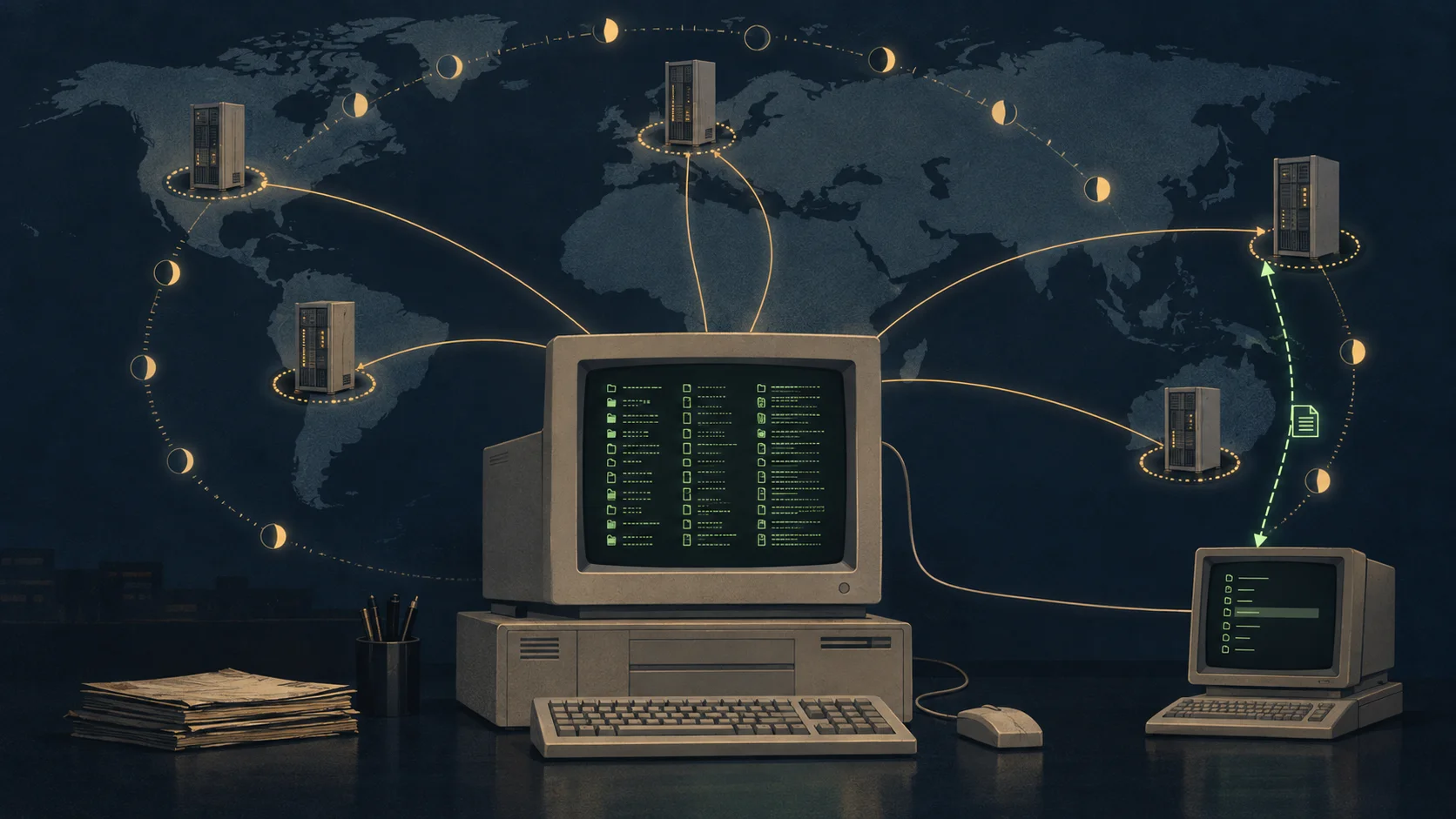
Archie’s Search Was Only as Fresh as Its Last FTP Listing

Archie made a scattered set of anonymous FTP archives searchable by collecting their directory listings. That small distinction shaped the service: its answer could point to a filename and a place, but the file still lived on someone else’s machine—and the index could only describe what it had last seen.

A beige UNIX workstation displays directory entries beneath a ring of remote archive servers; a separate green route connects one archive to a user's terminal.

Archie’s Search Was Only as Fresh as Its Last FTP Listing

Archie made a scattered set of anonymous FTP archives searchable by collecting their directory listings. That small distinction shaped the service: its answer could point to a filename and a place, but the file still lived on someone else’s machine—and the index could only describe what it had last seen.

  1. An Empty Field Was Not One Thing. RFC 3982 Made Absence Part of the Protocol
  2. The Smaller Number Had to Move First: RFC 3988
  3. The Picture Packets Arrived. The Decoder Rules Had Their Own Timeline: RFC 3984
Open History Session

Leadership Alliance

An OSI Address Had to Carry More Than a Route: RFC 1277

In 1991, OSI applications were already being tried over TCP/IP and X.25 networks that did not offer the OSI Network Service. RFC 1277 put the missing lower-layer clues inside an address the directory could already return. That made a connection attempt possible without making the encoded address a map of the route—or evidence that a remote application answered.

An archival address tile feeds TCP/IP and X.25 connectors, but the path stops before a dark service endpoint.

An OSI Address Had to Carry More Than a Route: RFC 1277

In 1991, OSI applications were already being tried over TCP/IP and X.25 networks that did not offer the OSI Network Service. RFC 1277 put the missing lower-layer clues inside an address the directory could already return. That made a connection attempt possible without making the encoded address a map of the route—or evidence that a remote application answered.

  1. The Channel Was Ready. Identity Was Still a Separate Question: RFC 3983
  2. A Phrase Traveled Without Its Author: Cory Doctorow and Interoperability’s Policy Boundary
  3. SNMP Had to Cross Routers to Manage Them: RFC 1270's UDP/IP Choice
Open Alliance Session